The game
How it plays
Twelve fictional teams contest an eighteen-race season for two championships. You own one of them and field two drivers. You develop the car between races, choose the strategy before each one and make the live calls during it. You do not drive.
Ten to fifteen minutes
A race weekend
The hardest constraint in the whole design. Rival management games run 15–25 minutes a race, which is a desk session. Chicane has to survive a commute — portrait, one-handed, interruptible, and a race that resumes exactly where a phone call left it.
Qualifying
~90 sThree knockout segments. Per segment: how many runs to spend, which compound, and when to go out. The track rubbers in as the session runs, so later is faster — until it isn't, because later is also busier, and a red flag ends the segment where it stands. Tyre sets come from one weekend allowance, so a second run in Q3 is a set Sunday will not have.
Setup
~45 sWing, suspension and brake bias, plus the starting compound and which engineer runs which car. The defaults are what your own engineers would arrive at, solved from the circuit — this screen is a place to gain an edge by deliberate deviation, not a toll gate. It locks when qualifying starts: trim for one lap and you start well and race badly.
The race
6–10 minThe main event, at 1×, 2× or skip-to-the-next-incident. Five live verbs and no more: pit now, pace, driver orders, answer a telegraphed event, and the radio. Twenty live controls make a cockpit, not a game.
Debrief
~60 sThe result, what it did to both championships, the paddock's reaction, and where the money goes next.
During the race
Five things you can do
Deliberately few. Constraining the live controls to a handful is what makes each one weigh something, and what keeps the whole race playable with one thumb.
01
Pit now
Box this lap, and choose the compound. Your cars never stop on a plan, never for a spent tyre, never even for the wrong compound in the rain. Every stop in your season is one you called.
02
Pace
Push, neutral or conserve as one tap — with engine and tyre modes behind them, because saving the engine and saving the tyres are not the same decision. Mixed settings are the point: maximum power on managed rubber.
03
Driver orders
Attack, hold position, swap, defend. With both championships live, ordering two of your own cars to stop racing each other is a real dilemma rather than a formality.
04
Answer the telegraph
An event arrives one to three laps before it lands, carrying its price. Box now and lose 22 seconds, or run it and risk the tyre. Either way the outcome is yours.
05
Radio
Your engineer offers a quantified, timed trade — “mode push, eight laps, three tenths a lap; it'll cost you tyre” — and every number is computed from the live race, so the simulation delivers exactly what was quoted. Stay silent and the driver decides in character, and you can still countermand it.
Between races
The factory, and the money
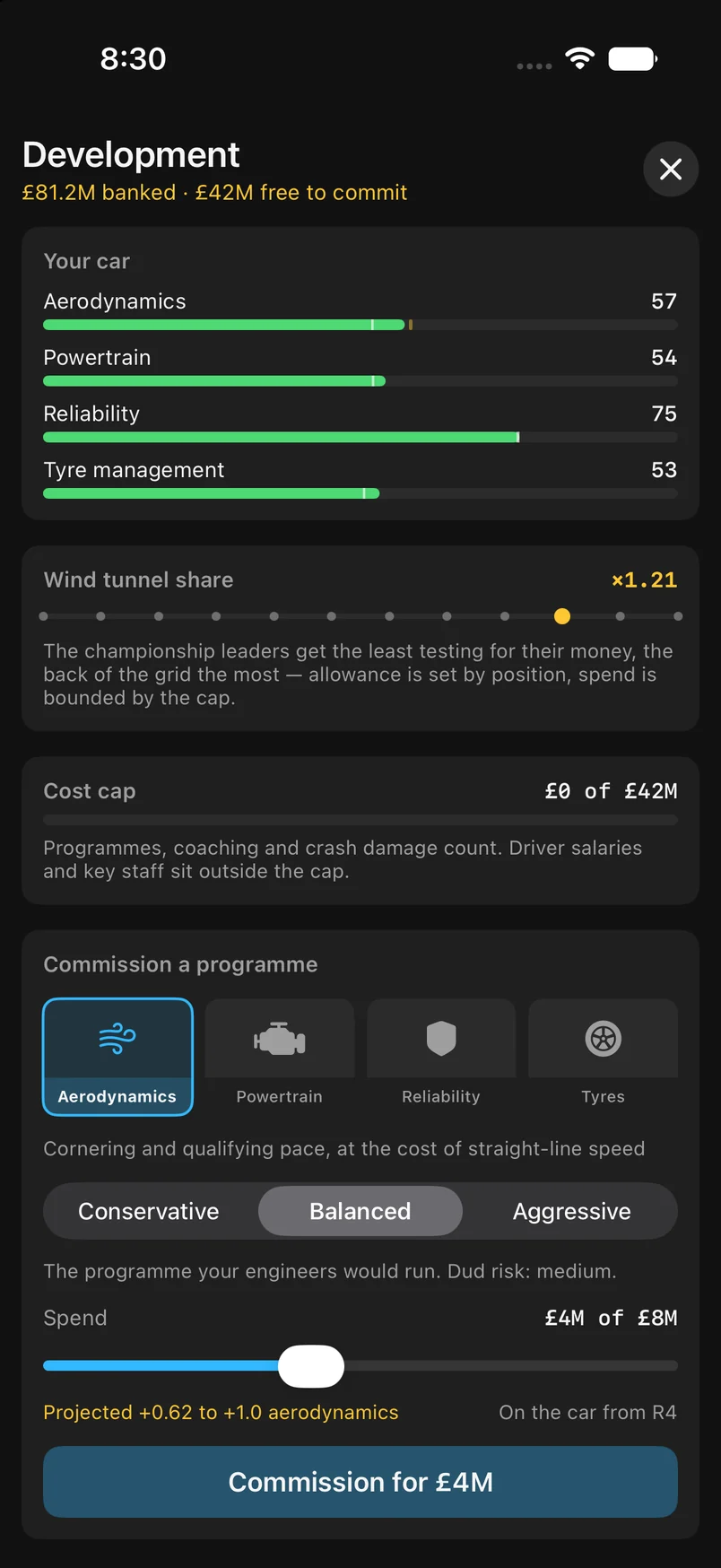
One currency runs the team. Broadcast income lands round by round, salaries go out round by round, and what banks up funds development programmes across four axes — aerodynamics, powertrain, reliability and tyre management, each worth more at some circuits than others.
And when it goes wrong
It tells you the truth
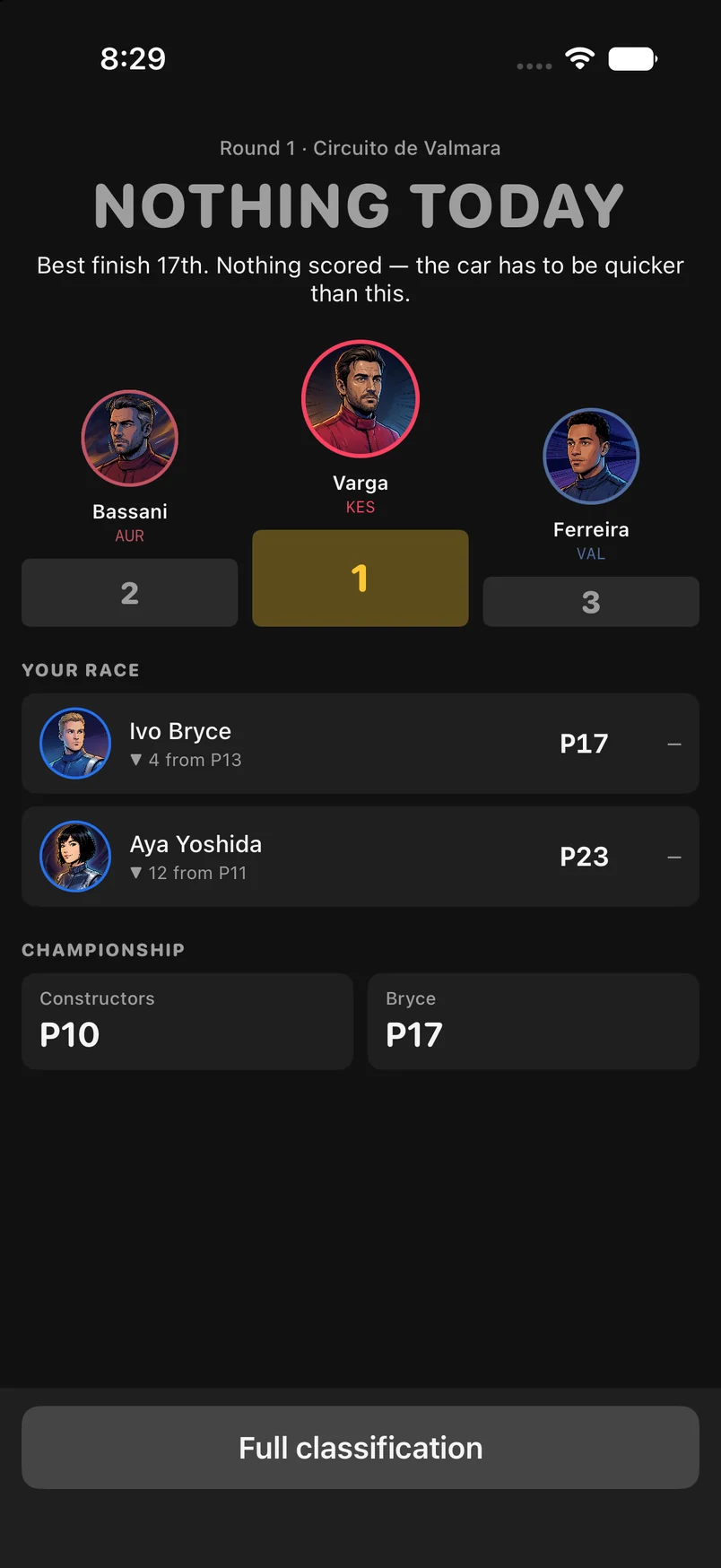
This is a real result from the season these screenshots come from. The rain came, the track dried, both cars were left out on intermediates far too long, and they finished seventeenth and twenty-third. The game does not dress that up.
It is also entirely recoverable — one bad race out of eighteen. That balance is the whole design: decisions should be legible enough to understand, tense enough to matter, and survivable enough that you want the next round rather than a restart.